


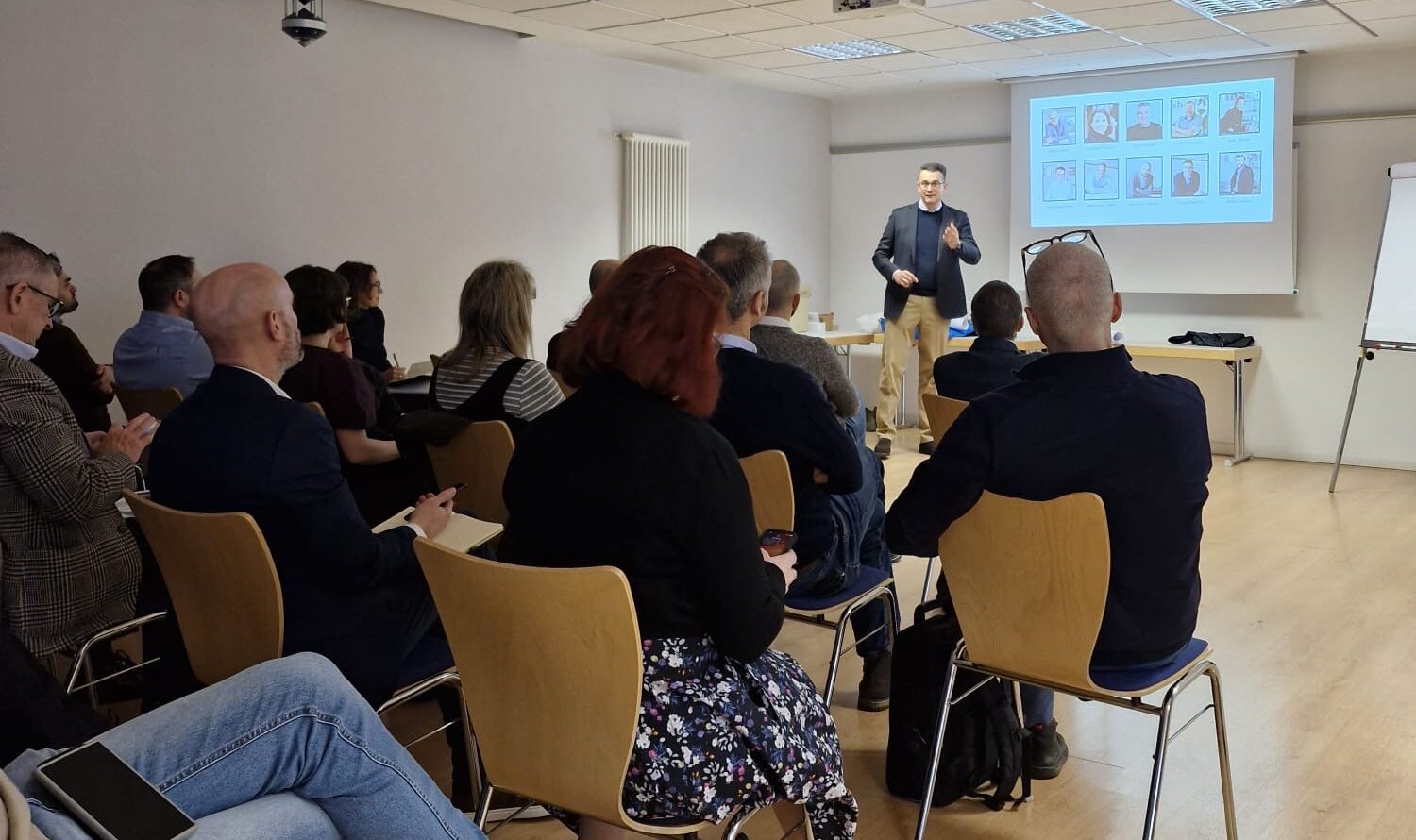
Learning about the practical application of sustainability in commercial kitchens – and the implications on design – was the focus of a consultant and operator ‘Sustainability Summit’ hosted by FCSI Allied member Ambach last week.
The event in Kaltern, Northern Italy, took place between 27-28 January. It saw FCSI Professional member design consultants from the UK, Italy, and Slovenia, plus executives from Hilton EMEA, tour Ambach’s facility and visit two hotel projects – at Hotel Mandelhof and Hotel Seeleiten – where the respective culinary programs are powered by state-of-the-art kitchens, supported by a Kitchen 4.0 infrastructure based on Ambach technology. But the primary focus of the event was on education.

The attendees, including FCSI-member consultants from H+K United, H44 Team, Hospitality Energy Saving & Sustainability, Humble Arnold Associates, PROprima, and Tricon, took part in a half-day, interactive learning session that was introduced by Ambach’s managing director, Mark Joseph Müller, who promised an “extremely inspiring” event in a region, visited by 5.3m tourists in 2025, which he believes is “the global benchmark when it comes to hotels and hospitality.”
Designing for resilience
Framing the education session within a forum of “inspiration, challenge, discussion, and even disagreement” for the attendees, Müller described the vital role that the process of foodservice design – and therefore consultants – had to play within “the ecosystem” of a modern kitchen. “Design thinking is a non-linear, interactive process,” he said.
A presentation from Paul Schöpfer, CEO of Ambach partner Creatus Group, followed, addressing the carbon footprint of commercial kitchens and how energy wastage can be reduced by operators through the help of innovation. “What we can’t see, we can’t optimize,” he said. “Transparency enables better behavior.” Saving energy in significant numbers (up to 30%) requires automation, monitoring and training, he added.
Professor Christine Vallaster of University of Salzburg then gave a talk on ‘Designing for resilience: co-creation, circularity, and measurable impact in professional kitchens’. “We need to stop seeing kitchens as products and start seeing them as systems,” said Vallaster. “Kitchens are amongst the most complex rooms in built environments. Every design decision creates behavioral consequences, and every behavioral change feeds back into the system.”
Vallaster also highlighted a shift from ‘bio-design’. which aims to reduce the environmental impact of a kitchen, to a more ‘sustainable product design’, where a kitchen is part of a circular system that can last and regenerate. “What if chefs were no longer treated as end-users of professional kitchens, but as key innovation partners, whose tacit knowledge of ergonomics, workflow, friction, and energy peaks help design circular systems that adapt over time and extend value across a kitchen’s lifecycle?” she asked.

The consultative approach
According to Khaled Halabi FCSI, managing director, H+K United, the event “was really unique,” because of its educational aspect. “The keynote speakers were really interesting. More [manufacturing] companies should adopt that approach – it really stuck with me.”
For Halabi, “developing relationships” at consultant-led trips such as these is vital. “We’re in a relationship business, so meeting manufacturers and other consultants – like minded people – means we are able to help each other better,” he said. He also praised the hotel reference visits. “To be able to speak to the chefs and say, ‘What do you like about this product?’, ‘Why do you use this product?’ – that kind of engagement, I really appreciate. It’s not easy to get access to these places after they open. So I really value that part of the experience.”
For Toby Magness, sales director, Ambach UK, “encouraging an open discussion about the carbon question” and helping to “fill in some of the gaps” in the attendees’ knowledge made the event particularly worthwhile. “To gather people in a more consultative approach, listen and understand, highlight some topics for discussion that were relevant, and and show some practical examples of how the technology has helped from our European partners, made this event a triumph,” he said.
“From my perspective, this is a movement that will shape the future of foodservice design. So, getting everyone around in friendly, open discussion and finding out exactly what the markets are demanding and how we can help, it’s been a great success. The feedback I’ve had regarding this consultative approach and a focus on listening and understanding what the issues are today, has been very positive.”
Michael Jones


