


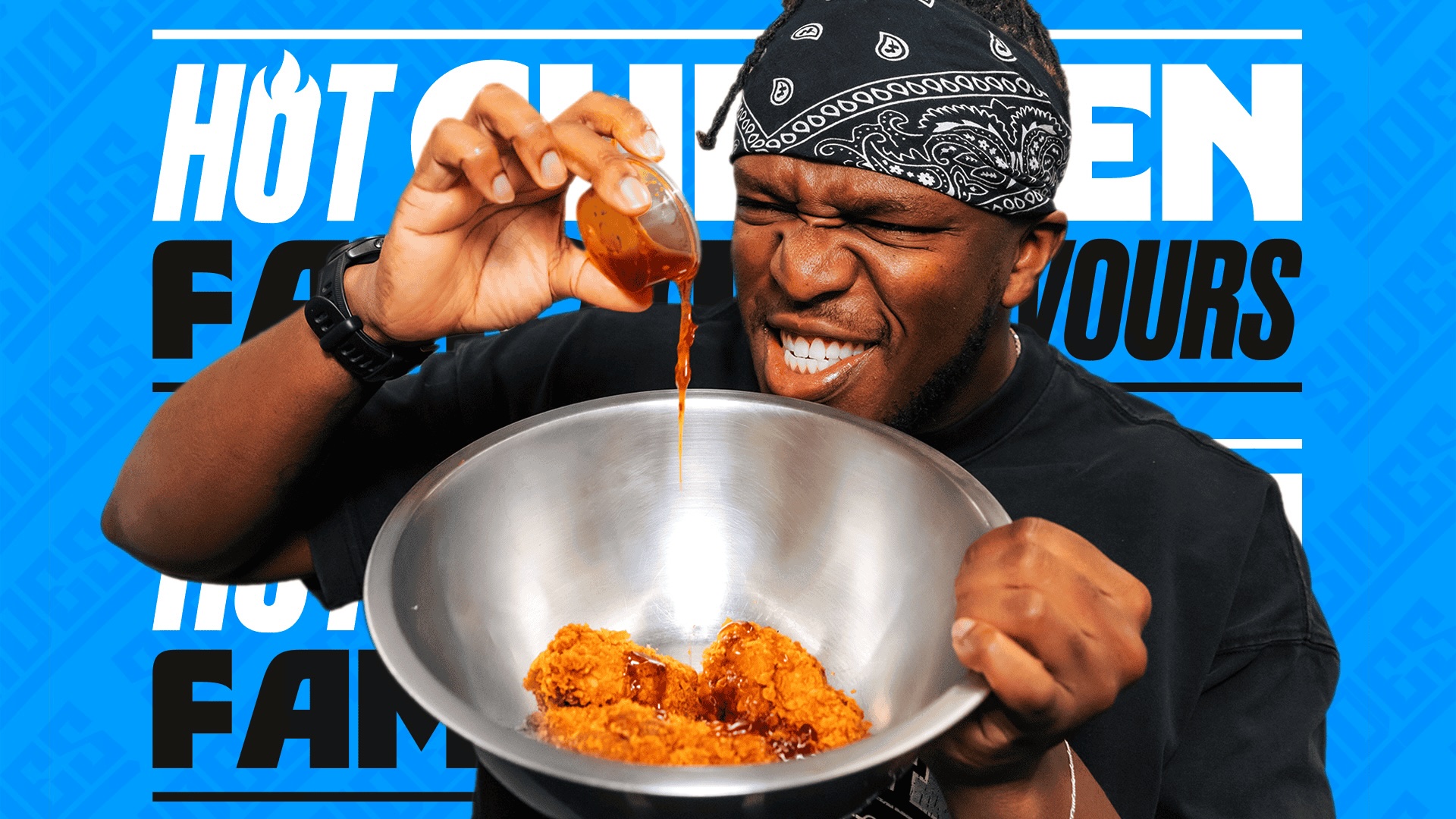
If you’re not quite in the right demographic sweet spot, you may not have heard of Sidemen – or their recent foray into foodservice. But your teenage kids most likely have.
Sidemen are a British YouTube collective consisting of seven members: KSI (Olajide Olatunji), Miniminter (Simon Minter), Zerkaa (Josh Bradley), TBJZL (Tobi Brown), Behzinga (Ethan Payne), Vikkstar123 (Vikram Barn), and W2S (Harry Lewis). The friends first began making gaming videos together in the early 2010s, before expanding their content into a wide range of challenges, sketches, and vlogs, most notably their weekly “Sidemen Sunday” videos, scooping up a jaw-dropping 120 million+ followers across their social media channels on the way.
The group has also built a large commercial brand around their name, with ventures including clothing, a membership club, and live charity events. And, since 2021, restaurants too. Their Sides fried chicken brand operates primarily in larger UK cities such as London and Manchester. It also has operations in the Middle East and a recent expansion into Asia with its first location in Singapore. Ambitious plans for further international growth – there is an aim for approximately 200 global locations over the next decade in regions including the UAE and Australia – have been announced by the brand.
The brand operates through dine-in restaurants where its freshly cooked Nashville fried chicken, side dishes, and sauces have gained plaudits – and got the tills ringing. Those ardent social media followers have been successfully turned into customers. On the delivery front, aggregator orders (from Uber Eats, Deliveroo and Just Eat) are fulfilled through the physical restaurant sites to ensure consistent quality.
Built for the conditions
All of this, in the UK in particular, amid a challenging market that has quickly become extremely competitive for premium fast-food fried chicken brands. So why then does Sides still see plenty of opportunity in the UK where other chains are struggling? “We see huge opportunity because Sides was basically built for the market conditions that we’re in now in the UK,” says Fiona Richards, marketing director of Sides (pictured below), who recently joined the chain.
“Ultimately we are a quality product. We are a culture-led brand and we have a scalable operating model. That combination makes us very resilient even in challenging market conditions. We’re very focused. We’ve got a really clear and unique proposition for a number of reasons. We are the only 100% British hot chicken brand and we’re hell-bent on delivering our mission to be ‘chicken famous’,” she adds.

Fiona Richards, Sides
The viral phenomenon
The hot chicken category, says Richards, “travels well, scales well, and resonates with younger consumers”, prompting the chain to focus on doing “one thing exceptionally well,” she adds. “We want to own that hot chicken category across our range of new viral flavors.”
And viral is certainly a key word here. Before Sides had opened a single store the Sidemen had already given the brand “a huge reach to digital communities in Europe,” says Richards. The average number of impressions the brand gets on its organic content is upwards of 12 million hits a month. “It’s just incredible; an absolute marketer’s dream,” laughs Richards. “It creates demand, and it also gives us that constant customer insight. We know what to respond to. We’ve got our finger on the pulse. We know what flavors people want and how that culture is shifted.”
The Sidemen community are incredibly passionate, “almost fanatical”, says Richards. “But the key thing from our point of view is we don’t just treat it as reach, we treat it as a relationship. We look then to convert that loyalty into footfall in three ways. Firstly, it’s authenticity. Sidemen are genuinely involved in the brand, the food, the marketing, and the cultural direction. So the fans know it’s real and in turn that that drives the trust. Secondly, from a content perspective, whenever we launch a new menu item we build those content moments around it. They’re not ads, it’s entertainment. We sit in a creator-led world. Our content travels across all channels – YouTube, TikTok, Instagram, you name it – and people are genuinely excited to to interact with it.”
Finally, says Richards, it’s about ensuring that the customer experience “matches the promise that you go out with”. You can bring a fan through the door, she says, but “they only come back because the quality of the food is good and they love the taste. The repeat rate actually is really strong because we give really good value, and great quality. Its bold, it’s distinctive, it’s fun, and it’s culturally connected.”
Overall the strategy isn’t about just borrowing the Sidemen audience, adds Richards, “it’s using their cultural influence to bring people into the brand and let them know how good the product is, and experience it. Sidemen are the fairy dust,” she says.
Reducing complexity, bringing the fun
Operationally though, the brand is aware it needs to get the right balance, says Richards. “We kept the menu deliberately very tight and the kitchen design super efficient. That means that we can keep that consistent quality, reduce the complexity and be more resilient to cost volatility. So, while the wider market is under pressure, we’ve got strong demand. Operational discipline gives us that ability to have sustainable growth,” she says.
Simplicity is key to the success, says Richards. “Streamlining that menu and executing consistently at speed. Category leaders have to be consistently reliable through every order on every platform, whether that’s through delivery or indeed through the in-store experience.”
Sides’s mission to own the hot chicken category in the UK and beyond is clear. From the enviable social media clout able to elevate the brand’s playful ideas – recent chicken recipes gaining huge traction online and subsequently in-store include ‘chocolate chicken’ and a new ‘roast chicken dinner flavor’ – to an unstinting focus on quality and consistency, and a keen eye on kitchen and operational efficiency, Sides is extremely well-positioned to weather market challenges and emerge on the other side, victorious. Just ask your kids.
Michael Jones


