


Sustainability is no longer a core idea in professional kitchens, but a concrete operational challenge. Rising energy prices, stricter regulatory requirements, Environmental, Social, and Governance (ESG) criteria in planning and operations, and growing awareness among operators and guests are leading to significantly increased demands on kitchen technology. Solutions are needed that combine environmental responsibility, economic efficiency and long-term operational reliability.
In addition to energy efficiency and optimised processes, the focus is increasingly shifting to the materials used. Stainless steel has been the standard in professional kitchens for decades – hygienic, robust and durable. At the same time, there is growing concern about the conditions under which this material is produced and the emissions generated in the process.
Stainless steel: durable in use, sustainably produced
Stainless steel can be recycled almost entirely without any loss of quality. Its outstanding material properties remain consistent even after multiple cycles of recycling. This stability forms the basis for robust constructions and appliances designed for a long service life in the day-to-day operations of professional kitchens.
But sustainability does not end with recycling itself. What matters is the proportion of recycled material used to produce the stainless steel, and the energy and production conditions under which it is manufactured. This is precisely where MKN comes in – with conscious material selection and transparency in manufacturing.
CO₂e transparency through traceable material allocation
Assessing CO₂ emissions is a complex process in industrial practice. Many sustainability concepts rely on offsets or certificates to balance emissions in the accounts. At the same time, differing methods, system boundaries and reference values make it difficult to compare specific material and product choices. This makes it more challenging for planners and operators to assess the environmental footprint of individual kitchen concepts.
MKN therefore pursues an approach based on transparent and material-specific CO₂e reduction. This is underpinned by collaboration with the European stainless steel manufacturer Aperam and its Aperam infinite™ programme.
This programme focuses on a very high proportion of recycled material in stainless steel production, optimised smelting processes and the use of low-carbon energy sources. This enables CO₂e emissions during the production of stainless steel to be significantly reduced.
MKN sources material from the Aperam infinite™ range for its SteelPlus stainless steel and incorporates this as an option into its own production. The SteelPlus option is used at MKN as part of a mass balance approach. The CO₂e-reduced stainless steel is incorporated into overall production, and the resulting emissions reduction is transparently reported and allocated to the relevant customer orders. MKN deliberately does not rely on compensation or offsetting models outside the scope of material production.
SteelPlus: material-based CO₂ reduction in practice
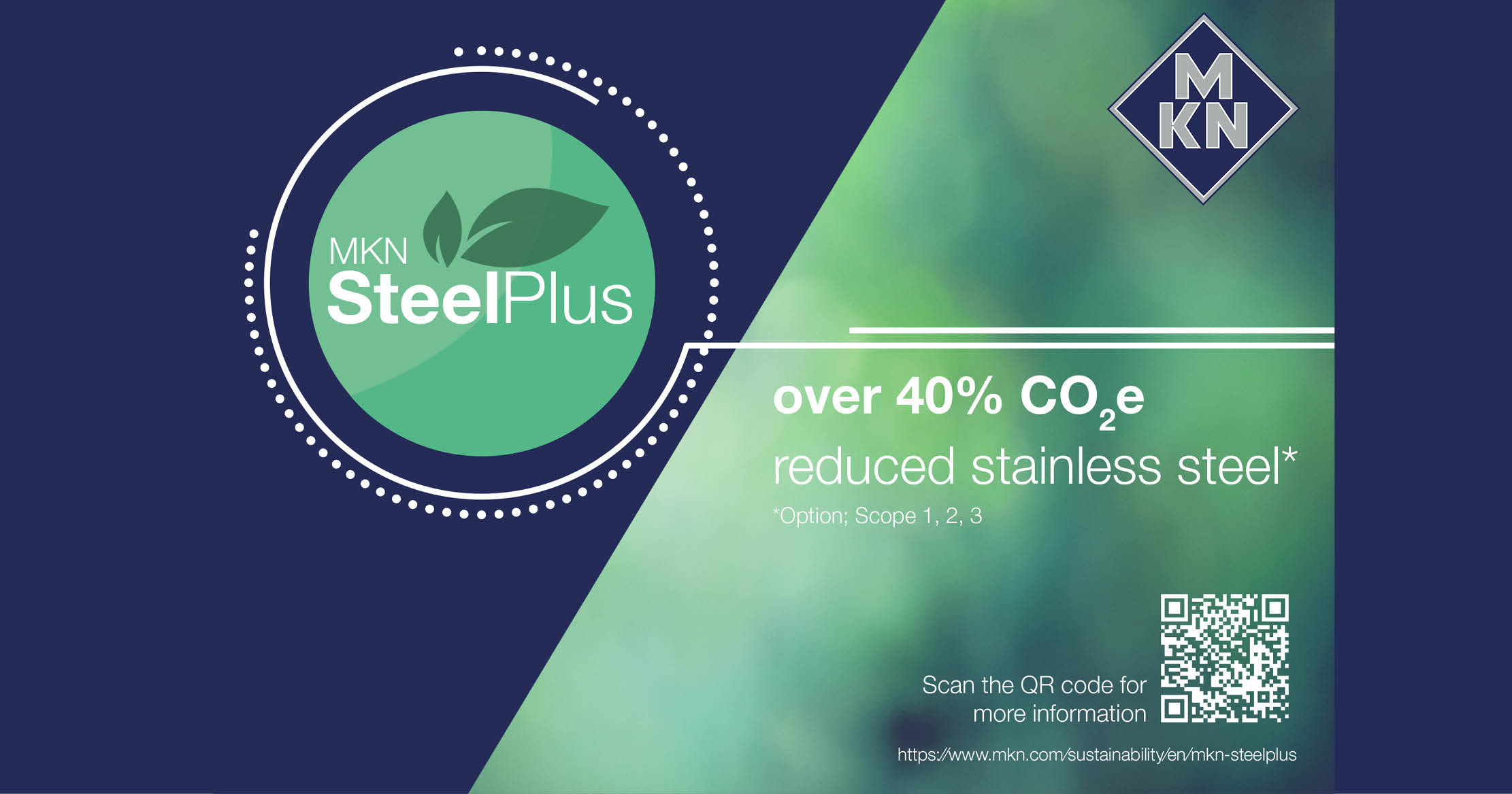
The stainless steel used contains around 98% recycled content and, relative to the stainless steel used, enables a CO₂e reduction of over 40% compared with the conventional stainless steel used by MKN.
SteelPlus is not a new material, but a CO₂e-reduced version of MKN’s tried-and-tested stainless steel. Its material properties correspond to those of conventional stainless steel and guarantee maximum functionality, hygiene and durability in daily use. In this way, MKN ensures that sustainability always goes hand in hand with durability, operational reliability and consistent quality – without compromising on everyday kitchen performance.
The impact is at the emissions level: for appliances configured with the SteelPlus option, the CO₂e savings from the stainless steel used can be quantified.
From material to appliance: measurable impact
Transparency is a key component of SteelPlus. The SteelPlus option makes it possible to clearly demonstrate the CO₂e savings associated with the stainless steel used.
If a kitchen is fully equipped with MKN technology, these material-related CO₂e savings can amount to well over one tonne of CO₂e in total when the SteelPlus option is used. The reduction occurs as early as the material production phase – that is, even before the appliances are put into operation.
For planners, consultants and operators, this transparency provides a robust basis for tenders, ESG documentation and investment decisions.
A building block for sustainable professional kitchens
SteelPlus is not an isolated material concept, but part of MKN’s holistic approach to sustainability. Alongside the materials used, energy-efficient cooking processes, durable appliance designs and digital control and monitoring systems play an equally important role.
SteelPlus exemplifies how manufacturers can make a measurable contribution to more sustainable professional kitchens through material-based decisions and transparent data – without adding complexity to operations.
Further details:
For more information, visit mkn.com.


