


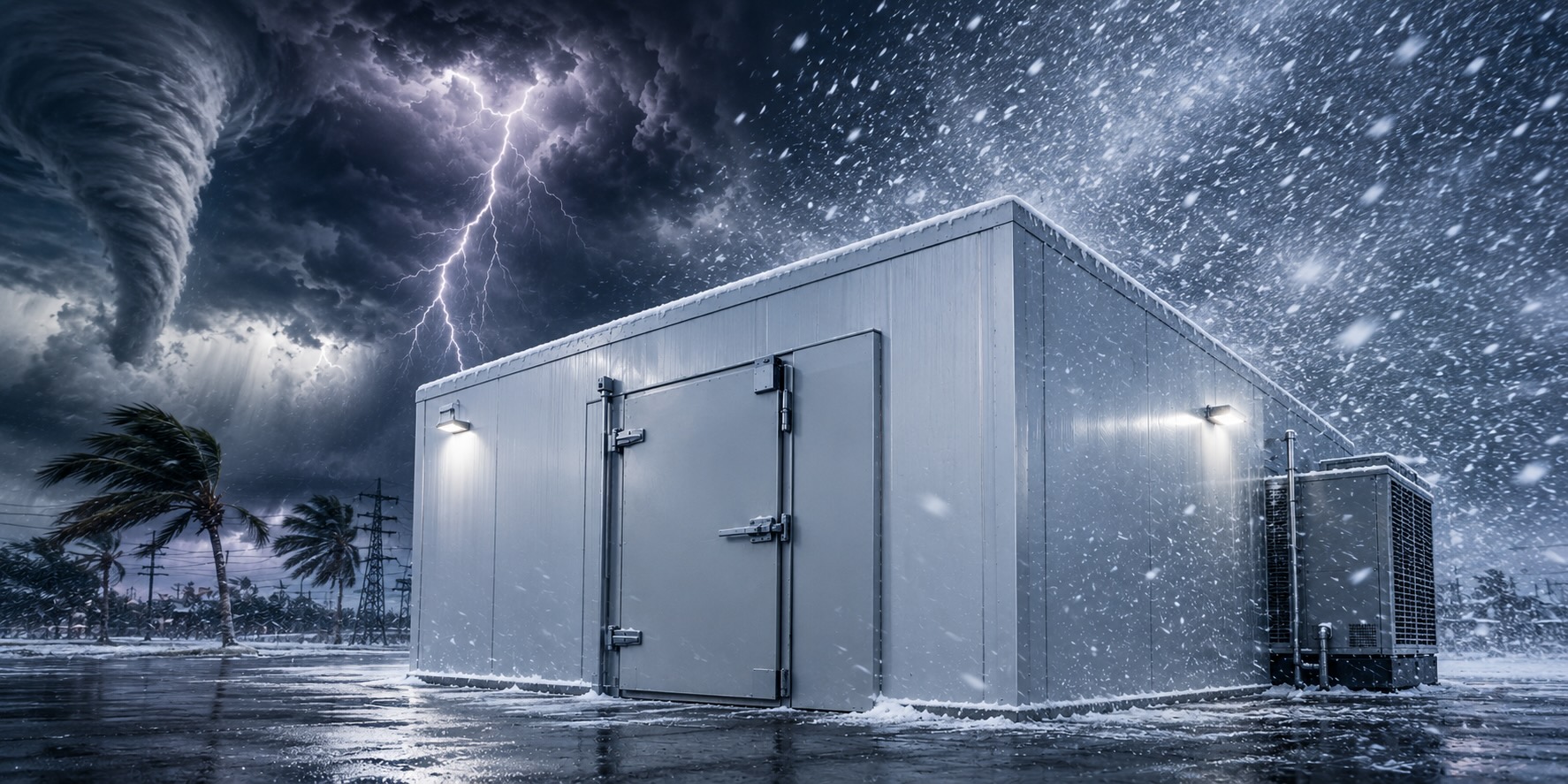
That need is the foundation of Amerikooler’s Resilience Series: engineered walk-in systems designed for durability, adaptability and performance in extreme environments, high-risk locations and mission-critical applications. For project teams, resilience begins with a broader question than “What size walk-in is needed?” It requires asking what regional conditions, operating risks and regulatory requirements the system must withstand throughout its service life.
Regional conditions drive design
A restaurant in southern Florida, a food processing facility in Minnesota, a pharmaceutical operation in California and a distribution center in Texas face different climate conditions, codes and structural demands. Wind and snow loads, seismic forces, sanitation requirements, floor loading, insulation performance and energy regulations should all influence the design process.
Outdoor walk-ins in hurricane-prone regions, including the Gulf Coast, Atlantic Coast and Caribbean, must be designed for higher wind pressures than many inland installations. High winds place substantial force on roof panels, wall assemblies, doors and anchoring systems. Without a design that accounts for these loads, roof panels can lift, doors may lose their seal, water can enter the insulated envelope and structural distortion can make repairs difficult.
Snow creates another type of risk. Designers in northern regions need to consider roof span, live loads, equipment weight, drifting snow and local ground snow-load requirements to help prevent excessive deflection and protect the refrigeration equipment supported by the structure. In California and other seismic regions, systems must also be engineered to accommodate earthquake forces without damaging insulated panels, refrigeration piping or supporting equipment.

Codes support resilience
Codes, certifications and independently documented test results should not be treated as paperwork added after the design is complete. They provide evidence that a cold-storage system has been evaluated for the conditions it is expected to face.
Depending on the location and application, project teams may need to consider high-velocity hurricane approvals, Miami-Dade documentation, seismic requirements and local acceptance criteria. Fire-related testing such as ASTM E84 and UL 723 helps evaluate flame-spread and smoke-development characteristics of building materials, while NSF construction requirements support sanitary operation in food-related environments.
Federal energy requirements, state energy codes and owner sustainability goals also affect cold-storage specifications. Documented insulation testing under ASTM C518, Department of Energy compliance requirements and International Code Council evaluations can help teams assess whether insulated-panel systems meet established performance expectations.
Moisture and energy matter
Moisture can undermine long-term performance. Humid air entering through poorly sealed joints or damaged components can cause condensation within the wall system, reducing insulation performance, contributing to ice buildup in freezer applications, promoting corrosion and increasing refrigeration operating costs.
Preventing these problems requires attention to both materials and installation. Closed-cell extruded polystyrene insulation is designed to resist water absorption while maintaining thermal performance over time. Properly compressed gaskets, fully engaged cam-locks, sealed penetrations and continuous vapor-barrier attention help keep moisture outside the insulated enclosure.
Energy efficiency is also central to resilience. Higher-performing insulated panels reduce heat transfer into refrigerated spaces, helping compressors operate more efficiently and lowering electrical consumption throughout the building’s life. As electrical grids experience greater demand and utilities implement demand-response programs, advanced controllers can help operators monitor performance, optimize defrost cycles, detect faults, communicate with building management systems and receive remote alarms before product temperatures become critical.
Plan for operational continuity
A resilient cold-storage strategy considers both permanent and flexible refrigeration needs. Reinforced, code-conscious walk-ins can support long-term operations in regions exposed to storms, snow or seismic activity. For temporary operations, emergency response, equipment outages or off-grid conditions, modular and mobile refrigeration can provide an additional layer of operational flexibility.
The Resilience Series brings these considerations together through engineered permanent walk-ins for high-risk regions and adaptable refrigeration options for evolving operational requirements. The objective is not simply to meet baseline performance expectations, but to help businesses reduce downtime, product loss and long-term risk exposure when disruptions occur.
Installation completes the design
A properly engineered system still depends on correct installation and commissioning. Panels must be aligned properly, cam-locks fully engaged and gaskets evenly compressed. Electrical and refrigeration penetrations need to be sealed, floor systems installed on properly prepared surfaces, and refrigeration equipment given adequate clearance for airflow and maintenance.
Installation shortcuts can remain hidden until condensation appears around panel joints, ice develops inside a freezer, doors become difficult to close or energy costs increase. Proper startup should include refrigeration verification, control calibration, door adjustment, temperature confirmation, documentation and operator training.
A lifecycle perspective
A walk-in is part of the building envelope, a structural, thermal and operational system expected to protect product for decades. This makes the lifecycle value more meaningful than initial price alone. Lower energy consumption, structural durability, easier maintenance, reduced downtime and dependable performance can outweigh initial differences between proposals over the life of a facility.
Amerikooler’s Resilience Series reflects a broader approach to cold-storage infrastructure that combines structural resilience, code-conscious design, advanced insulation and adaptable deployment options. By addressing regional hazards, applicable requirements, energy performance, sanitation and installation quality early, owners and project teams can help turn cold storage into a stronger foundation for business continuity.
Further details:
For more information, visit amerikooler.com/.


