


Whether born of brief flashes of inspiration, brilliant minds, eureka moments or simple common sense, the foodservice sector is driven by pioneers who have had the courage of conviction to start something new. Not all new ideas succeed, but those that take hold and gain traction often serve to shape the world into something new and different. In this – incomplete – list we celebrate some of the people, products and places that have left an indelible mark on the world of foodservice.
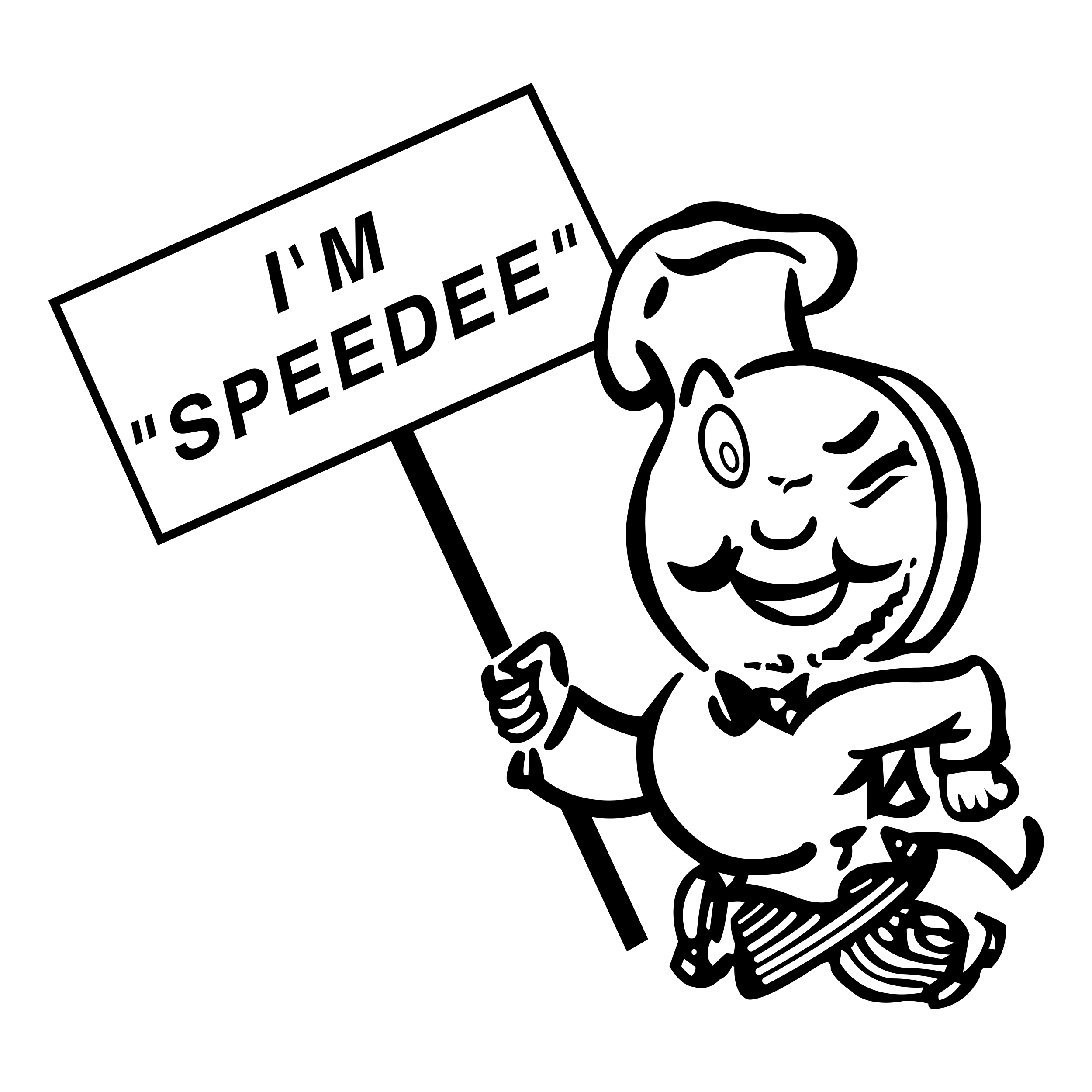
Richard and Mauricee McDonald
The original entrepreneurs behind McDonald’s and the inventors of the Speedee Service System, the brothers opened the first drive-in restaurant in California in 1940. Their system was the precursor for modern fast-food systems.
Ray Kroc
Widely known as the founding father of fast food. Kroc spent his working life as a travelling salesman of items such as paper cups and mixers to cafés across the US. He came across a new concept in San Bernadino, where the McDonald brothers had set up a simple and efficient operation with no table service, food prepared on assembly lines and served on paper plates. Kroc went on to franchise the McDonald’s brand across the nation and the world.
Julia Child
The chef, author and TV personality who brought French cuisine to the American public with her book Mastering the Art of French Cooking and her wildly popular TV cooking shows, chiefly The French Chef, which launched in 1963.
Auguste Escoffier
The man most associated with the birth of modern French cuisine, Georges Auguste Escoffier has been hailed as “the king of chefs and chef of kings” thanks to his unparalleled contributions to French cuisine. His most notable innovation was the introduction of the brigade de cuisine, a hierarchical system inspired by his military experience. This structure introduced a new level of order and efficiency to professional kitchens, assigning specific roles to staff members and streamlining operations.
Ferran Adriá
Pioneered molecular gastronomy – a term he has never been entirely happy with – as he served up spherical olives, parmesan balloons and hazelnut caviar in what was one of the first examples of a large tasting menu in fine dining. elBulli today lives on as a museum and it paved the way for a whole generation of young chefs who set out to break boundaries in the kitchen.
Starbucks
Introduced the coffee house as the third space – away from home and the office – and launched a playful range of iced drinks. While the Frappucino was an innovation that had been invented by Boston’s Coffee Connection, it was supercharged as a concept after the Seattle company acquired the smaller coffee chain. Many other game-changing concepts have followed since – Pumpkin Spice Latte anyone? Starbucks set the standard that many have emulated, and arguably improved, in the years since the original store opened in 1971.

Colonel Harland Sanders
While not the inventor of franchising, colonel Sanders pioneered modern franchising in food with KFC. After a successful launch of his famous fried chicken in the 1930s, he was forced to close at an age when most would consider retiring. He instead set off to travel across the country franchising the concept. The first KFC franchise opened in Salt Lake City in 1952. Today, there are more than 30,000 KFC restaurants across the world and the Colonel will forever be remembered for his persistence and resilience.
Alice Waters
The chef is recognized as the most influential pioneer of farm-to-table cooking, since opening her now world famous California restaurant Chez Panisse in 1971 and has inspired a generation of cooks. Waters transformed dining by championing organic, locally sourced ingredients long before it became mainstream. A vocal proponent of simplicity in cooking and care for the environment, she is also the author of books such as The art of simple food and We are what we eat: A slow food manifesto. More recently, through projects such as the Edible Schoolyard Project, she has worked to educate children about healthy, sustainable food.
The cronut

Invented by Dominique Ansel, the cronut, a hybrid of a croissant and a donut, was launched in 2013 and opened the floodgates for a whole subgroup of pastry hybrids: the cruffin, the cretzel, the brookie, and the duffin, to name a few.
Siegfried Meister
It is true that the German entrepreneur didn’t invent the combi steamer, but after opening Rational AG in 1973 he certainly refined it, making it more practical, programmable and reliable to use in commercial kitchens. Combining steam and convection heat, the concept existed in some form, but had failed to gain traction as early models were difficult to use and unreliable. Since the first efforts of Meister, more than 50 years ago, Rational has been a leader in professional combi steamers – now found in most kitchens – and has been followed by many competitors.
Dorito Loco tacos
The first product to go viral in the social media age, The Dorito Loco Taco was unleashed on the market in 2012 by Taco Bell. Three years in development, the R&D department allegedly spent two years on developing the right kind of taco shell. The launch was timed to perfection, just as social media was booming, and the product went viral. Within 10 weeks of their launch, over 100 million Dorito Loco Tacos had been sold and it became the fastest consumer product to sell a billion units, doing so in just under three years.
René Redzepi

The Danish-Albanian chef put Danish gastronomy firmly on the global map with Noma (a play on ‘Nordisk Mad’, which means Nordic Food in Danish). Three times voted the world’s best restaurant, Noma will go down in history as a pioneer of hyper local sourcing and looking for ingredients closer to home.
Jamie Oliver
Author of 35 cookbooks, Oliver first made an appearance on TV in 1999 when he was scouted in the kitchens of famed London restaurant The River Café to appear as cheeky chap The Naked Chef. Such is his influence that he straddles food and activism – including campaigns for better school dinners and employing newly released prisoners – and his achievements outside the kitchen are just as important as those at the stove.
Stainless steel
A genuinely transformative element in the evolution of the commercial kitchen, stainless steel has been a pioneering material, enabling catering operations to exist in the form we know today. Quite simply, without it, the open, modular, hygienic kitchen layout would not be feasible. The most innovative technology – combi steamers, blast chillers and ovens to name a few – rely on the corrosion-resistant alloy developed by British metallurgist Harry Brearley. It is sustainable, hygienic and long-lasting and has added efficiency to kitchens.

José Andrés
Needs little introduction. The chef (left) from Asturias in Northern Spain emigrated to the US in 1990 and has created an empire of restaurants. Today, he is more famous for World Central Kitchen, an organization that activates local networks of chefs in natural or man-made disasters to help get food on the table for those in need.
Anthony Bourdain
A true maverick with few equals among chefs, Bourdain was part of the generation that made cooking sexy with his tell-all account Kitchen Confidential. He arguably created a whole new category of food travel TV with his wildly popular TV series, including Parts Unknown. Missed by friends and fans since his untimely passing in 2018.
Eugénie Brazier
If Escoffier is known as the godfather, Eugenie Brazier is simply the mother of French cuisine. Uneducated and untrained, she went on to become the most decorated chef in the world – in 1933 she was the first chef to be awarded six stars by the Michelin Guide, unmatched until Alain Ducasse achieved the same feat in 1998. Largely unknown outside French gastronomy, she continues to serve as an inspiration to female chefs and others who visit her Lyon restaurant La Mere Brazier, which remains open today with chef Mathieu Viannay on the pass.
Eleven Madison Park
Took fine dining to a new level on several fronts, with Will Guidara embracing a particular kind of hospitality in the dining room and Daniel Humm in the kitchen. Having received three Michelin stars and been named the world’s best restaurant, the pair split. Humm pursued a plant-based fine dining experience – and made it a success. Having seemingly proved a point, he has reintroduced meat to his menu.
Tina Nielsen


