


Two counters face each other. One serves hot food: a staff member plates up at one end, diners add finishing touches at the other. Opposite, a fresh produce counter with a backlit ‘garden greens’ sign. Between them, an island with bananas and prepackaged snacks. At the walls, a drinks fridge and a rack of chips.
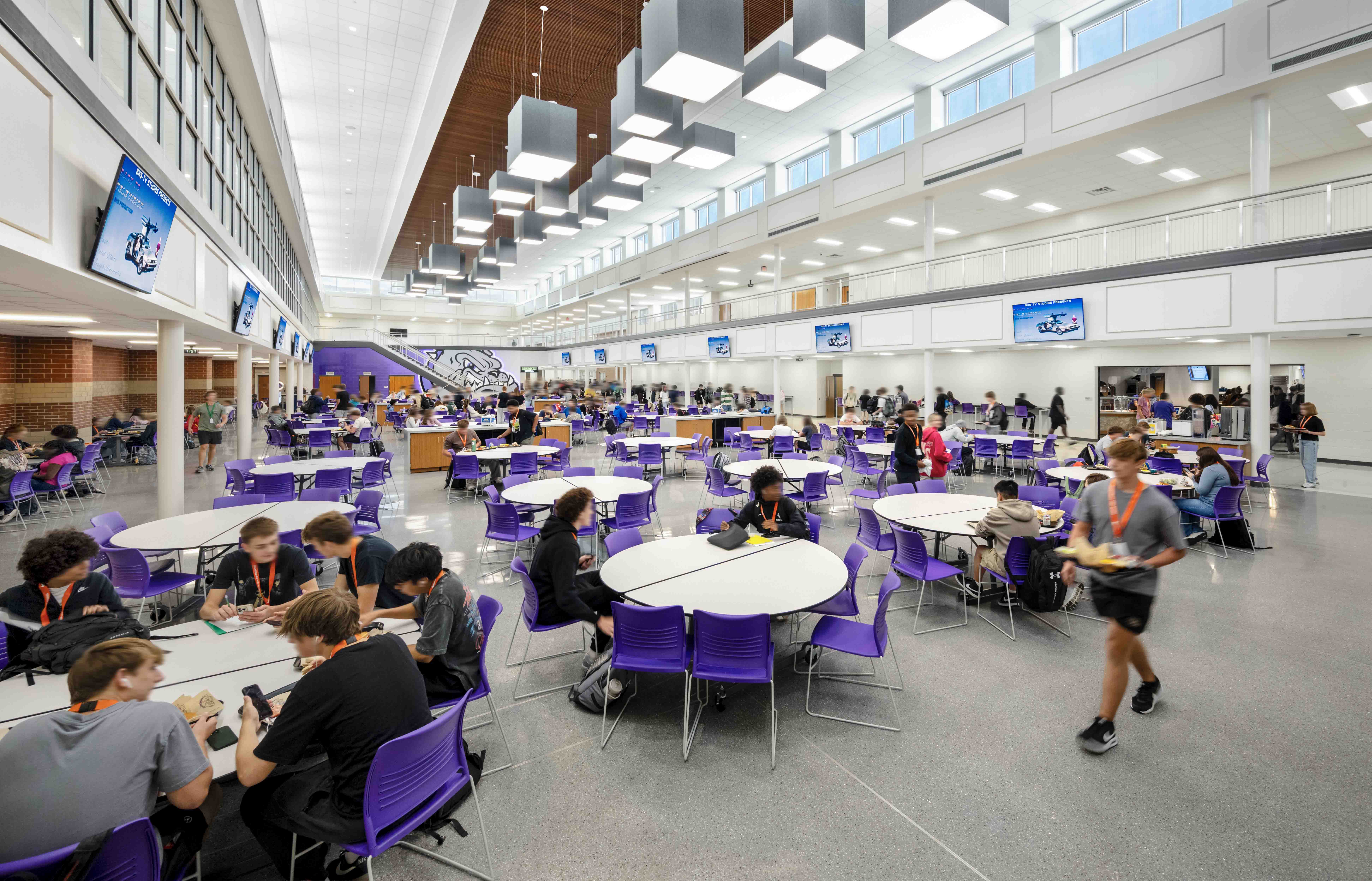
What looks like a fast casual restaurant is, in fact, the main servery of the Senior Academy of Brownsburg High School in Indiana, recently renovated by Reitano Design Group. “Before the renovation, seniors complained the food was better on the other side of the school, but it was coming from the same kitchen,” recalls principal Scott Reitano FCSI. It was, he argues, a question of presentation, and improving it was central to the brief.
This anecdote illustrates how a principle of commercial foodservice – the environment is half the dining experience – applies to school lunch programs too: design is now used to nudge students toward healthier choices. “We want to serve healthier school lunches. But if nobody’s eating it, we didn’t win. That’s where the environment comes into play,” explains Reitano.
Environment includes everything from how food is displayed to how the space is organized around it. “Traditional rigid serving lines are often no longer ideal,” says Charlotte Kolb-Bönkhoff FCSI, of Germany-based kitchen planning firm Kolb Planung. “Children are highly sensitive to how food looks, how long they need to wait and whether they are offered genuine options.”
Glenn Campbell FCSI, founder and managing director of UK-based Cohesion Consulting, points to the research: “The placement of food on a servery, at eye level, front of the queue and well-lit, has a measurable effect on what children select. A salad bar positioned before the hot counter can increase vegetable uptake significantly. A dining room that feels like a canteen signals institutional food; one
that feels like a café signals something worth choosing.”
The difference between a child eating and not eating fruit can be as small as a sliced apple, Reitano explains: “At elementary schools, we put the fruits and vegetables first. We slice apples and section oranges; 68% more kids will eat them that way.”
A strategic asset
As the role of school foodservice design has grown, so has the ambition of school lunch programs. Traditionally, school dining has served as a social equalizer – a guarantee that every student, regardless of background, sits down to a nutritious meal – but the role has expanded. For Julian Edwards FCSI, director of GY5 Foodservice Consulting and chair of FCSI EAME, “the biggest shift in school dining is philosophical: school food is no longer seen as a cost center but as an investment in well-being, behavior and school culture. The canteen is a strategic asset.”
Kolb-Bönkhoff adds: “The communal lunch table has become an important element of daily interaction in many schools. Studies indicate positive effects on nutritional status, cognitive performance, school attendance and, in the long term, educational outcomes.”
Know your student
For design to work, it has to start from who students actually are. “Today’s student is a grazer,” says Reitano. “They’re not breakfast, lunch, dinner kids anymore.”
The new cafeteria at Noblesville High School in Indiana offers a telling example: while working on the project, Reitano found that traffic peaks at 10–11am and again at 1–2pm, as students roll through from an adjacent study area throughout the day.
This compounds a common issue in US K-12: lack of proximity to food. “The national average lunch break in the United States is 23 minutes,” says Reitano. “Students go there, throw some food down and then go back to class.” The design response to both challenges is distributed dining: “We’re putting food where the students are, spreading it across the building, in smaller environments and available throughout the day,” he says.
Then there are the expectations kids form outside school: “Kids today care about choice at a much earlier age,” says Wendy Surak, SVP of operations at Sodexo At School. “According to research by Datassential, 68% of Gen Alpha parents take their kids out to eat at least once a week and 52% say they let their kids pick their own meals.”
Asking students directly is, Edwards argues, the most reliable approach: “Taste panels with pupils are invaluable – they’re honest, and they tell you what adults often miss. Sadly, many caterers believe children do not like salads and will not venture beyond what they know, but that’s not true. Children are far more adventurous than they’re often given credit for.”
Reitano puts it in starker terms: “Gen Z and Gen Alpha look for a different experience. We call it the Chipotle method. They want their food customizable, fresh and fast – not a burger wrapped in tinfoil that’s been sitting there for who knows how long.”
The tension between students’ expectations and nutritional requirements is not lost on large operators such as Sodexo: “We need to design meals that fit with all the federal guidelines and still deliver food they find interesting enough to eat,” says Surak.
Growing up
What today’s students want, however, is only half the challenge – the design must also evolve as they do. This is most evident in the US, where – unlike in most European systems – lunch programs run until the end of high school. Reitano Design Group’s portfolio maps this evolution: simple design, limited choice and clear educational messaging in elementary schools; named concepts replacing generic counters and global flavors starting to appear in middle school; by high school, design is indistinguishable from commercial food outlets.
“We want students to form some healthy habits at elementary school, to reinforce them in the middle school years, and to respect their palate as they get older,” says Reitano. “Our high school environments look more like collegiate environments these days.”
Market Central, the recently renovated quick servery at Brownsburg’s Senior Academy, illustrates this well. A walk-in cooler stocked with drinks, prepackaged salads and sandwiches, and a counter with a digital menu board that lists buffalo dip, bento boxes and other items – telling students to select three to five components, including at least one fruit or vegetable. It’s school food, but not as we know it.
Think of it as a convenience store with the nutritional mission embedded in the menu.
Andrea Tolu


