


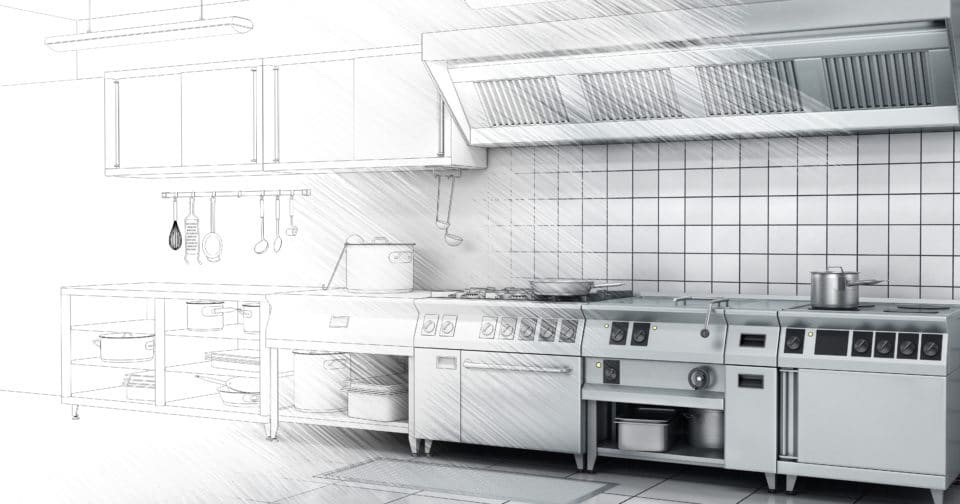
Foodservice designers are often tasked with the challenge of creating kitchens and back-of-house spaces without the benefit of direct collaboration with chefs or operators. While this scenario is far from ideal, it is an increasingly common reality in today’s hospitality sector, where project timelines, budget constraints, and shifting personnel can leave designers working with little more than a brief and a hope. The absence of operator insight can turn what should be a collaborative process into a delicate balancing act, where designers must anticipate needs, pre-empt pitfalls, and deliver spaces that are not just functional, but resilient in the face of the industry’s evolving pressures.
Critical issues such as energy efficiency, staffing constraints, and ingredient supply – all through a pragmatic, industry-focused perspective that keeps sight of the ultimate goal: creating kitchens that work, even when the path is anything but straightforward.
While this article focuses on restaurant environments, it’s important to remember that the principles of resilient foodservice design extend well beyond hospitality venues. Other sectors – including hospitals, correctional facilities, and industrial foodservice – face many of the same challenges, such as tight project timelines and budget constraints. However, these settings often have additional layers of complexity, such as heightened regulatory requirements, higher volumes, or the need to cater to specialized dietary needs. In hospitals, for example, designers must balance efficiency with stringent hygiene and food safety protocols, while in correctional and industrial settings, durability and security considerations come to the fore.
The core strategies – prioritizing adaptability, logical flows, robust equipment, and future-proofing – remain equally relevant across these diverse foodservice environments. By applying these principles universally, designers can help ensure that a wide range of operations are equipped to thrive despite uncertainty and change.
Robust solutions – but also efficient and sustainable
Energy use in professional kitchens is notoriously high, with equipment running at full tilt for long hours and ventilation systems working overtime to keep the environment safe. When designing without direct input from chefs or operators, the challenge is to specify solutions that are not just robust, but also efficient and sustainable.
The foodservice designer’s key difficulty lies in understanding the true patterns of use. Without operator feedback, it’s tempting to over-specify – to allow for every possible scenario – but this can lead to unnecessary energy consumption and inflated running costs. Conversely, underestimating requirements risks bottlenecks, equipment failure, and a space that simply cannot cope with demand. Striking the right balance demands a clear-eyed assessment of the likely menu, service style, and throughput, informed by market trends and operational benchmarks rather than untested assumptions.
Integrating energy-efficient appliances, specifying induction over gas where possible, and designing for zoned operations (so that only necessary areas are powered up at any one time) are all practical steps. Designers must also consider the long-term sustainability of their choices: specifying equipment that is easy to maintain and upgrade, planning for future energy sources, and ensuring that ventilation and extraction are sized to actual need, not just worst-case scenarios. Ultimately, efficiency is about designing in the flexibility to adapt, not just the ability to endure.
Flexible and functional
The foodservice sector is facing a well-documented staffing crisis, with labor shortages and high turnover rates now the norm rather than the exception. For designers, the absence of operator input makes it even harder to anticipate staffing levels, skills, and workflows. The solution lies in designing spaces that are as flexible as they are functional.
This starts with clear, logical flows that minimize unnecessary movement and make it easy for staff to multitask or cover for each other. Compact, well-organized workstations and intuitive equipment placement can all help reduce training times and lower the risk of errors. Consideration should also be given to sightlines and communication: open layouts and visual connectivity between stations can foster teamwork and allow fewer staff to manage more tasks.
Recent years have highlighted the fragility of food supply chains, with ingredient shortages and delivery delays becoming regular challenges. For designers, the lack of operator input can make it difficult to predict which ingredients will be used, in what quantities, and how frequently they need to be accessed.
The answer is to build adaptability into storage and handling. Flexible cold and dry storage spaces, adjustable shelving, and modular racking systems allow operators to respond to changing menus and supply chain hiccups without major reconfiguration. Where possible, bulk storage should be balanced with easy access for high-turnover items, and as always there should be clear separation to maintain food safety standards.
Designers should also consider the potential for alternative sourcing – for instance, specifying storage and prep areas that can accommodate a wider range of ingredients, or allowing for the integration of new equipment as menus evolve. This approach not only helps operators weather the uneven supply chain but also allows them to experiment with new dishes and suppliers as market conditions change.
Prioritize flexibility, simplicity, and futureproofing
In the absence of direct operator input, the best weapon in a designer’s arsenal is a commitment to resilient, adaptable design. This means prioritizing flexibility, simplicity, and futureproofing at every stage of the process.
- Modular layouts: wherever possible, use modular workstations and equipment that can be reconfigured as needs change.
- Clear zoning: prep, cooking, and service areas with logical flows to reduce cross-contamination and improve efficiency.
- Technology readiness: build in infrastructure for automation and smart systems, even if they are not installed at the outset.
- Robust documentation: provide clear, accessible manuals and signage to help new staff get up to speed quickly.
- Stakeholder engagement: Where direct operator is not available, the original brief for the project should provide sufficient guidance for the foodservice designer.
These strategies, while not a panacea, create spaces that can adapt to changing circumstances and support operators as they respond to the unpredictable realities of modern foodservice.
Designing a kitchen or back-of-house space without direct input from those who will ultimately use it is never ideal. Yet, with careful attention to energy efficiency, staffing constraints, and ingredient supply, and a commitment to practical, flexible solutions, foodservice designers can create spaces that are not just functional, but genuinely resilient.
The key is to approach each project with curiosity, drawing on the best available data, engaging with a broad range of stakeholders, and always keeping sight of the end goal: a kitchen that works, no matter what the future throws at it. The best design is not just about solving today’s problems, but about equipping operators for the challenges yet to come.
Tim Smallwood FFCSI


