


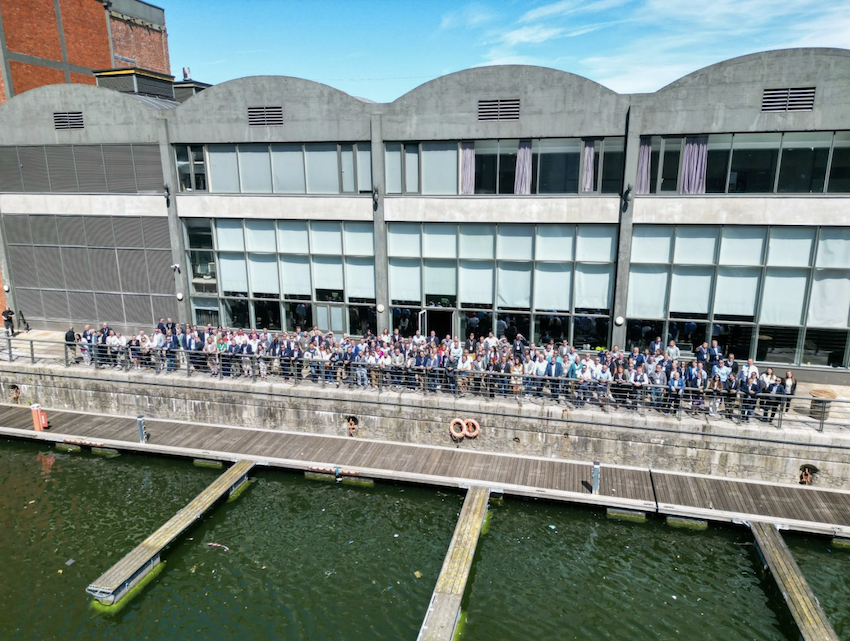
“People here are massively open-hearted,” were the warm words of Nisha Katona MBE, founder of Mowgli Street Food. Her comment conveyed the conference theme, HEART, which explored five topics: Humanity, Environment, AI/Automation, Responsibility, and Togetherness (HEART).
Taking place at the iconic Titanic Hotel Liverpool, the FCSI global community reunited to share insights and ideas, fostering opportunities for consultants and manufacturers to find solutions to challenges, make purposeful new contacts, and even forge friendships.
This year, it was clear that flexibility, empathy and adapting to an evolving landscape were key narrative threads onstage, and that the opportunities for connection via the FCSI network remain unparalleled.

Sharing solutions
The two-day event featured insightful discussions, moderated by 1473 Media’s Michael Jones and Tina Nielsen. Friday began with Liverpool Hope University’s food historian Professor Bryce Evans, who highlighted Liverpool’s role in global food history, its pioneering Chinatown, its maritime influences, and its connection to foodservice.
Invito Design’s Danny Potter FCSI then described how his team delivered Olympia, London’s newest entertainment destination and a £2.6bn regeneration project, powered by the FCSI Allied member community of equipment manufacturers. Insights also came from Richard Fordham from Sicotronic UK, David Bean from Fosters Coldstores, and Scott Taylor from Alto-Shaam, who addresses how flexibility was key to balancing sustainability and design.
“The real power is being able to stand there and represent the client and talk to the manufacturer, support them all the way through and figure out how you get to the end,” said Potter.
Next up was the conference’s first HEART session, a brilliant panel with Claire Moss FCSI from Kre-ate Ltd, Richard Haddad FCSI from Aventra Hospitality and Marta Cebrián López FCSI from MCL Food Consulting and vice president of FCSI Iberia, exploring ‘Human engineering in foodservice design’:
“Human engineering is taking the time to look at what the workers are doing in a kitchen, bar or front of house to measure how they move, their steps, to understand how to improve their working conditions. It’s about observing and bringing solutions to their workspace,” said Cebrián López.
Flexibility and empathy are key, emphasized Moss, especially when accounting for the long term, and in creating environments that hospitality staff actually want to work in.
“If you don’t create the right environment, you get a higher turnover of staff, and it’s costly to replace them,” added Haddad.
Paying it forward

The afternoon showcased one of FCSI’s greatest USPs; championing the intergenerational collaboration shaping the future of FCSI as we heard about the latest developments for FCSI’s College of Fellows with Ken Winch FFCSI and William Caruso FFCSI, followed by FCSI’s Emerging Professionals in Consulting (EPiC) members (pictured below), who mapped out the path for the next generation and what effective collaboration looks like between generations. The panel, moderated by Nielsen, addressed the importance of building purposeful connections and supporting one another across the network.
“We are looking for people to connect with other people, to grow the future of FCSI,” said Moss.
The EPiC cohort shared inspiring ambitions to diversify who the next generation might be, and why this will be a key strength:
“Diversity is a chance for every person to win in a diverse environment, so we want to encourage a diverse community and invite everyone to be part of it,” added Juan Manuel Umbert FCSI.
Addressing the ‘Environment’ pillar with a presentation on replacements for single-use plastics in foodservice, we heard from Alexandra French, CEO of Xampla, who shared some sobering figures. “80% of the plastic we’ve ever made is still with us on the planet today,” said French, who demonstrated the biodegradable technology behind Morro™ materials to reduce a reliance on plastic and the opportunities for using plant proteins in foodservice packaging.
In her closing keynote, Katona shared how her 20 years as a barrister shaped her leadership as the founder of Mowgli, highlighting the importance of cultivating working cultures rooted in nourishment and developing people: “If you predicate your business on your people, if you can keep your people really nourished and fulfilled, then the company runs itself,” she told Jones.

“Grace. Intelligence – emotional intelligence, that is – and graft are the key things I look for in staff. I have a zero-tolerance policy on graceless behavior,” she added.
The day closed with attendees enjoying dinner and tours of Everton Football Club’s stunning new Hill Dickinson Stadium.
Day 2: Automation, Responsibility and Togetherness
On Saturday, Jones moderated a panel focusing on ‘AI and Automation’, which featured Giorgia Lardner FCSI from Cooper8 Ltd, Khaled Halabi FCSI from H+K United, and Primoz Cernigoj FCSI, from PROprima d.o.o. Foodservice consultants, said Lardner, “love problem solving,” seeing the burgeoning issue of AI in foodservice operations to be a puzzle that needed to be solved using profession’s unique strengths in dealing with “processes and emotions.”
Emma Best, operations director of Eurest, part of the Compass Group, next addressed how the key to being a ‘Responsible’ business was to create a “supportive, collaborative culture” within the business, cascaded those qualities throughout a team and empowering them to “live and breathe” them. Best shared how her company has built a business based on boosting wellbeing and productivity through carefully crafted menus, setting ambitious, time-bound targets regarding carbon emissions, food waste, and focusing on sustainable sourcing.

Closing out the ‘T’, an FCSI Worldwide board for a panel focusing on Togetherness, partnership and collaboration, moderated by Nielsen. “We all share the same problems around the world, so for me to come here and find someone else whom I can share those problems with and learn from is so helpful. This organization has a real openness. We share information, and we’re better for it,” says Phil Llewellyn FCSI, chair of FCSI Asia Pacific Division, on stage with Frank Wagner FCSI, president, FCSI Worldwide; Brent Hall FCSI, chair, FCSI The Americas; and Julian Edwards FCSI, chair, FCSI Europe, Africa, Middle East.
The panel truly captured the essence of FCSI events and the role of community at the heart of everything the Society stands for. It left the 230+ attendees leaving Liverpool with new ways of thinking, inspiration for focused decision-making, and a contact list of brilliant new connections and friends. Coming away from these events, one thing always rings true: that FCSI continues to thrive because of its invaluable, people-first community.
For more information on speakers and to reflect on the event, browse your FCSI EAME HEART26 event program here: link.
Lauren Hurrell


