


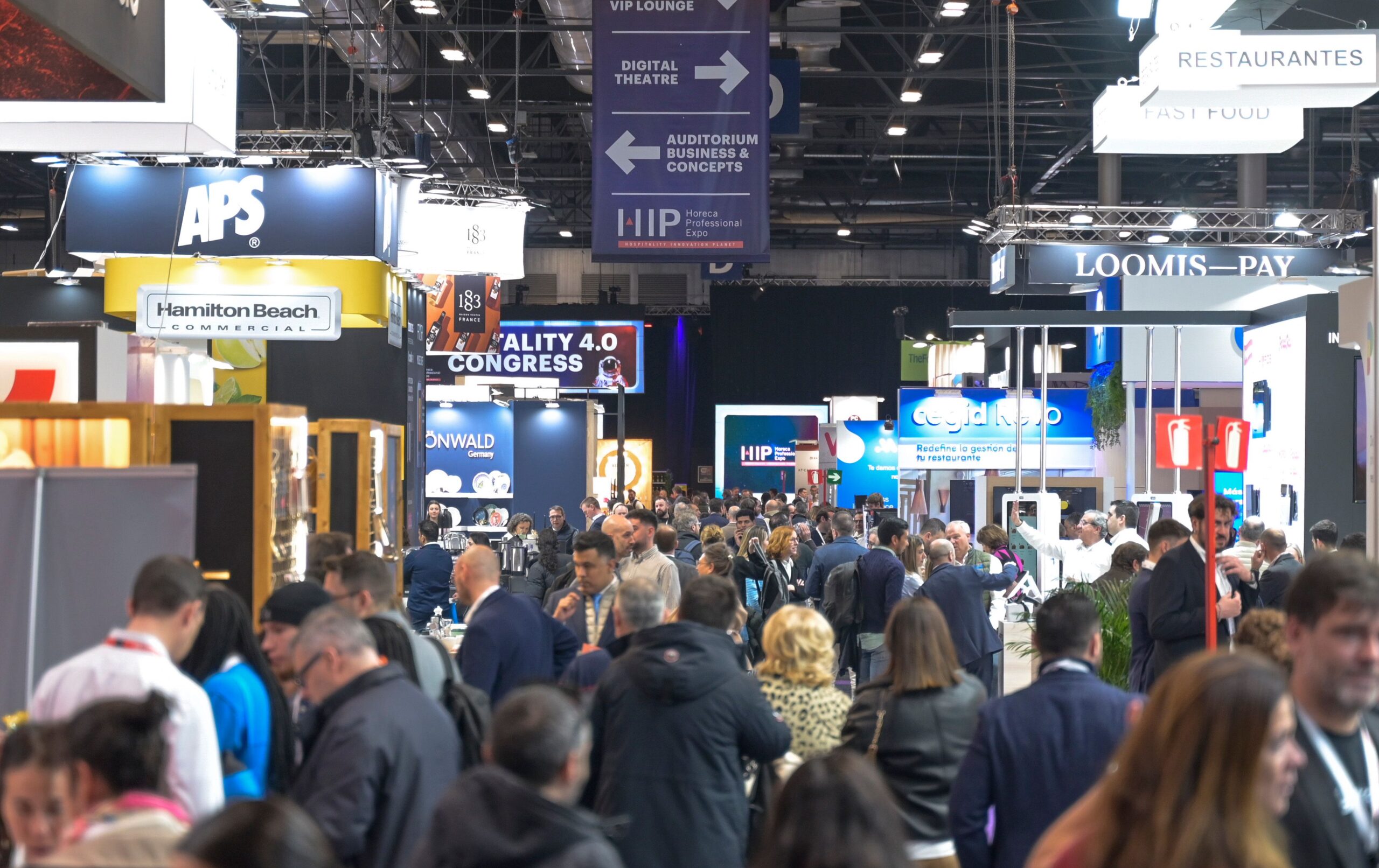
As HIP prepares to welcome professionals from across the sector, the scale of the event reflects a decade of ambition and growth.
“We launched HIP with the idea of improving and transforming hospitality, first in Spain and later at an international level,” recalls show director Manel Bueno. “We wanted to create a high-value event that would help to professionalize the sector and make Spanish hospitality more competitive, because it is a very important link in the tourism chain, which is crucial to the country’s economy.”
HIP was conceived as an event to combine the traditional trade show model with a significant congress element, to support hospitality professionals in areas such as digitalization, operational improvement, strategic thinking, and team development. The aim, says Bueno, was always to create an event where people could learn things they could take back and apply directly to their own businesses. “That is the key,” he explains. “It’s not just another traditional food trade show or a gastronomic forum like those that already existed.”
This year, HIP will welcome nearly 1,000 exhibiting companies spread across four IFEMA halls. The event has grown by almost 30%, occupying halls 3, 5, 7 and 9. Hall 9, the largest at IFEMA, will be used almost in its entirety, including the foodservice area, after hosting only a small section last year.
Visitor numbers are also set to rise, with organizers expecting to exceed 60,000 professional attendees. Around 80% are business owners or senior executives – true decision-makers within their organizations. “These are not people coming just to stroll around,” says Bueno. Alongside the exhibition, the congress program will run across 10 auditoriums in parallel, featuring more than 35 summits and over 700 experts.
Bueno describes HIP as the largest platform and the biggest European trade show offering 360-degree solutions for hospitality. “There are other events that are larger in equipment, or more important in food,” he says, “but when you put together everything a hospitality business needs – digital solutions, design, foodservice, equipment, new concepts and new business models – there is no other event like it.”
While HIP spans multiple halls at IFEMA, what truly sets it apart is the scale and depth of its congress program, designed to cater to every type of business and every kind of hospitality professional.
This year’s theme
The theme for this year’s conference is Next level unlocked, a phrase borrowed from the gaming world that reflects HIP’s evolution after its first decade and its readiness to move forward at a new level.
Among the new features for 2025 is a standalone coffee, bakery and gelato zone, which has seen remarkable growth. “The volume in this sector has grown significantly – by 50%,” says Bueno.
Another major addition is Sala Experience, a new summit focused on front-of-house excellence. Organized in collaboration with Juan Diego Sandoval of Coque, the program will bring together some of the best dining rooms in the world. This year’s highlights include a three-Michelin-star Japanese restaurant from Tokyo and Colombian restaurant El Chato, recently ranked number one in Latin America.
The Global CEOs Summit will offer a platform for international hospitality leaders from Asia, the Americas and Europe to share their concepts, performance insights and the challenges they face in an increasingly complex market.
Technology and production remain central to HIP’s proposition. The Smart Kitchens & Equipment Hall will welcome manufacturers and equipment dealers showcasing the latest innovations in foodservice technology. “We have always focused on equipment and the latest technology to support food production,” says Bueno. “Processes are key. At the end of the day, a kitchen is a factory: it can be as artisanal or as automated as you want or need, but it is still a factory producing dishes. You could even say that a bar is a beverage factory. It is the heart and lungs of your business – how you organize it and what equipment you use is extremely important.”
Consultants take center stage
The recently established FCSI Iberia will have a significantly expanded presence at HIP this year. Its stand will evolve into a meeting point for consultants, manufacturers and industry colleagues, reinforcing the role of consultancy within the wider foodservice ecosystem.
FCSI Iberia will also organize the Foodservice Leadership Summit on 17 February, bringing together consultants and foodservice experts to discuss the most pressing topics facing the sector today.
“Consultants are a very important and interesting link in the chain,” says Bueno. “Nowadays, everyone calls themselves a consultant, but it has become clear over the years that hospitality is a very complex business. You need to master many areas – sales, marketing, purchasing, supply chain, operations and people management.”
The presence of FCSI at HIP helps position the foodservice consultant as a valued and credible part of the industry landscape. “Even very good entrepreneurs or professionals don’t know everything,” Bueno adds. “Whether you’re a small business looking to grow, a medium-sized company or a large organization, an external consultant can help by saying things that people close to you might not be able to say.”
He says FCSI can provide that umbrella and seal of quality. “Being part of the association signifies a reputable professional with a proven track record of success and professionalism,” he concludes – a message that aligns closely with HIP’s mission to elevate standards as it propels the hospitality sector forward.
HIP will take place on 16, 17, 18 February at IFEMA in Madrid. For more information, visit: www.expohip.com
For a special FCSI member discount on Premium and VIP passes, click here
Tina Nielsen


