


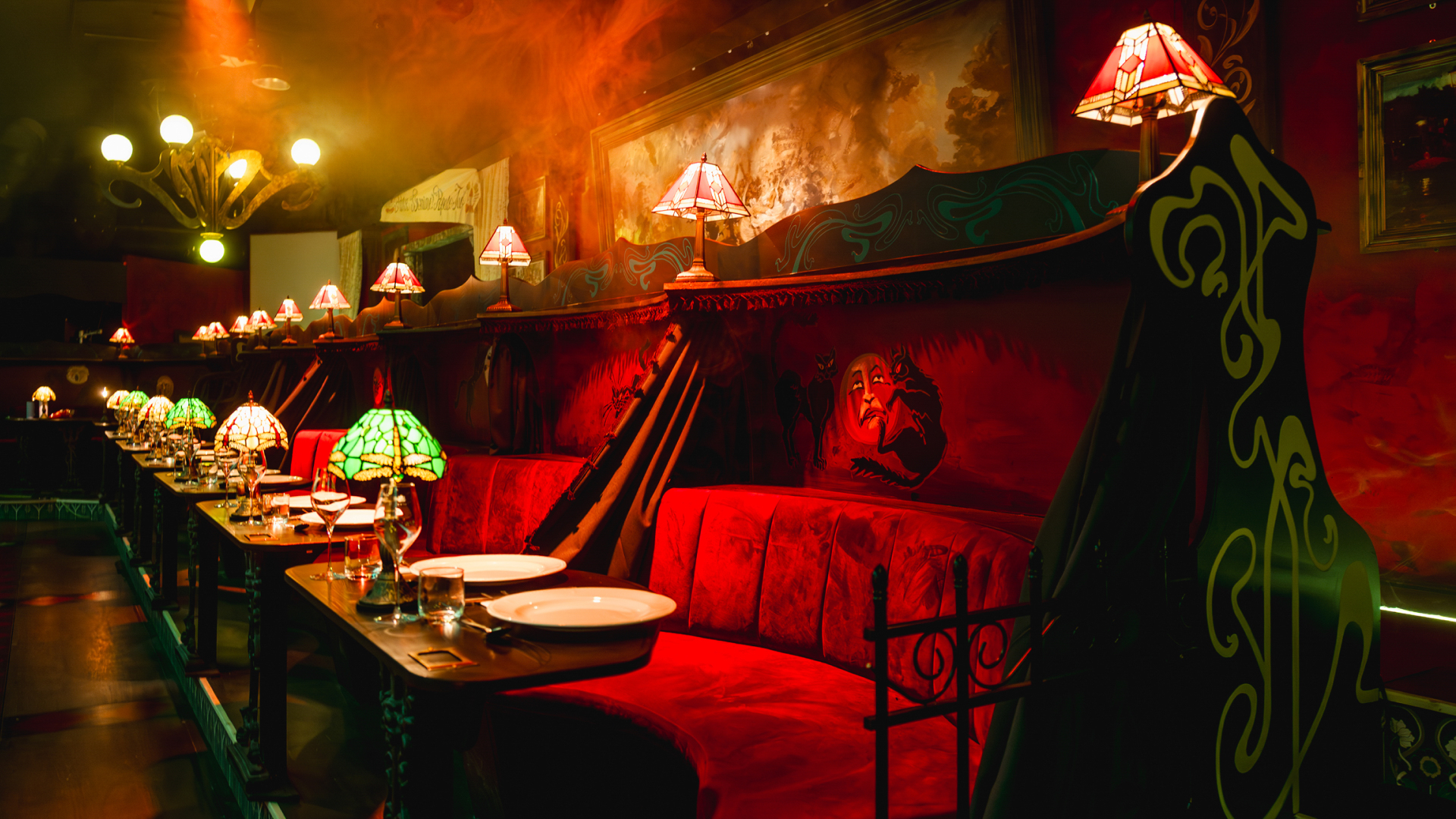
The Chat Noir! experience time-travels guests through taste and performance, leaving the streets of West London to emerge from the other side of the secretive velvet curtains into 1890s Paris. Guests are guided through the immersive story of the original Le Chat Noir club in Paris, one of the first avant-garde cabaret clubs that heralded the performance art form, opening in Montmartre in 1881.
Over four hours, guests enjoy three acts and a three-course meal inspired by vintage Parisian cuisine. The Lost Estate brings the cabaret club to life, drawing guests into an underworld of artistic invention and new ideas.
In a room of punters, actors, and waiting staff, almost everyone is dressed in silks, velvets, waistcoats, lace, and dark romantic evening wear. The logistics of the evening are complex but well-executed. Each detail is embellished with decadent attention. Everything feels carefully designed, from the menus, cocktail glasses and the dimly lit set design around us to the foodservice operations themselves.
“The foodservice operation is very complex. At the outset, a lot of the focus is on how we deepen storytelling through hospitality – using food and cocktails as part of the narrative, to create a story,” says Eddy Hackett, co-founder and executive producer of The Lost Estate. “One of the most interesting expressions of that is the use of absinthe in the second act of the show, where it brings an amazing ‘absinthe dream’ to life in a tangible way, through our absinthe drips.”
Dinner and a show
The journey is structured around the story of Chat Noir’s revival: guests are introduced to the club’s three incarnations and then guided by The Lost Estate on a time-travel experience through the second era, led by Rodolphe Salis. During this, guests witness how Salis united artists, musicians, poets, thinkers, and bohemians under a whimsical artistic vision, resulting in iconic, groundbreaking art. Every staff member, performer, and guest becomes a player in the scene-setting, with staff members bestowing interactions that place us in bohemian Paris, prompting guests to lean into the experience to gain more from it.
“Alongside the club itself and the people, we were looking at everything happening culturally at the time: the emergence of Escoffier’s approach to French cooking, the richness of Belle Époque mixology, and the broader design potential.”
The menu also offers an extensive wine list, Paris-inspired and absinthe-infused cocktails, and mocktails and inventive soft drinks for those who prefer non-alcoholic beverages. Both meat and vegetarian options are available for the three-course set menu. Choices include coq au vin, lemon tart, charcuterie, and vegetarian alternatives. These are interspersed with captivating performances and enhanced by set design and lighting, allowing guests to drink and dine at a leisurely pace in a holistic celebration of analogue connection. Guests move fluidly between food and performance, admiring both in tandem and contributing to an elevated experience of both.
“The cuisine of that period marks the emergence of French fine dining. The techniques are very simple, but they also need to be techniques that work for the food for it to be executed well,” says Hackett. “Take our main course, coq au vin – it’s a simple dish in theory, but to bring it to life in a technically consistent way for the high number of guests requires a huge amount of planning.”
Across the evening, theatrics increase in three parts: art, absinthe, and anarchy. These happen between food and drink courses. Waiting staff provide natural, hands-on service that grounds guests amid the fun. Service is discreet, seamless, and timely, as plates of food and drinks are served at intervals around the performances without disrupting them.
“We have an excellent team led by Ashley Clarke, our executive chef, who oversees both recipe and menu development, as well as scaling of the dishes to serve 228 covers,” says Hackett. “That means creating highly accurate, standardized recipes – from ingredient measurements through to cooking processes, oven timings and holding times. Every stage is carefully calibrated.”
The promise of escape
Fans of food, drink, theatre, and reverie will be wowed by this immersive experience. With the immersive experiential category booming, particularly as younger consumers are going out less but spending more on experiences, the appeal is strong. The inspiration for the experience’s connection is clear, with much of the enjoyment coming from watching other guests lean in and react to the activities around the room and to interactions with staff and actors.
“Live music, live performance and hospitality remain at the heart of what we do,” says Hackett. “At a time when people are being offered more and more digital experiences across their lives, I feel there’s going to be a point where people want to remember what it means to be human and seek out that feeling of being alive through real-life experiences.”

Bohemian Paris comes to London in a vivid, immersive fever dream, eliciting great tastes and excitement that cultivates a refreshing desire to let go of inhibitions and lean in, with sensory experience at its core.
“These are moments that simply can’t be replicated online,” says Hackett. “The stories we tell allow people to connect with one another, to confirm their identity and feel part of something tangible and human – I think that’s one of the reasons immersive experiences will become increasingly prolific.”
Lauren Hurrell
Pictures: Nick Ray, Joe and Charlotte, H Leatherby


