


K-12 dining environments are evolving.
Schools want dining spaces that feel welcoming to students and help give kitchen staff a more efficient workflow. At the same time, consultants working with these districts often face strict budgets, compressed construction schedules and meal programs that can change from year to year.
These pressures make the choice of serving system increasingly important, considering the role school meals have on student health, focus and academic performance.
So how do you determine whether modular serving systems or custom counters are the better fit?
Both approaches can create engaging foodservice environments, but each offers distinct advantages depending on the priorities of the project.
For consultants, the decision often comes down to how a serving system supports three key factors:
- Project timelines
- Operational needs
- Long-term adaptability
Why schools are choosing modular counters
Modular serving systems are built from coordinated units that connect to form a complete serving line. Instead of fabricating an entire counter from scratch, consultants can configure components to match the space’s layout and service style.
For many school districts, this approach offers practical benefits ranging from faster installation to stronger student engagement. In one Alabama school district, the foodservice team reported a noticeable improvement after installing modular serving lines.
“SpecLine (modular) serving lines came in perfectly, and they are the most beautiful red you have ever seen. Our participation jumped at least 20%. And this was all done in a matter of hours,” said a foodservice professional at Midfield City Schools.
Here’s why consultants recommend modular counters:
Faster project timelines
Because the units are pre-engineered, projects can often move more quickly from specification to installation, which can be especially valuable when renovations must be completed during short school breaks.
Predictable costs and results Predictable costs and results
Predictable costs and results
Modular counters can deliver many of the visual and functional benefits of custom at a lower cost. Also, their attention-grabbing look and top-quality feel encourage student participation in school meal programs.
Flexibility over time
Flexibility over time
As meal programs, service models or student participation change, modular counters can be rearranged, expanded and updated. Individual units can also be serviced without shutting down the entire serving area, helping staff keep meals on schedule and students make the most of their free time.
When custom counters make sense for schools
Custom serving counters remain an important option for certain K-12 school projects.
Because they are fabricated specifically for a space, custom counters allow for precise design control and can integrate seamlessly with a building’s architecture.
They may also be the right choice when a district wants a highly branded dining environment or when a layout requires specialized dimensions that standard components cannot easily accommodate.
For projects where the serving system is intended to remain unchanged for many years, custom fabrication can provide a permanent, built-in installation tailored to the school.
Learn more about modular serving systems
Every school has different foodservice requirements, from available space to student population and staffing levels. Understanding these factors and the strengths of both modular and custom counters can help consultants recommend the right serving counter.
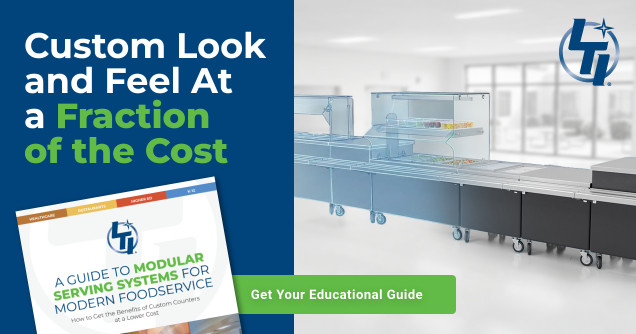
In the 8-page education resource A Guide to Modular Serving Systems for Modern Foodservice, you’ll learn how modular systems can:
- Reduce specification and installation timelines
- Adjust to evolving layouts and service models
- Support efficient workflow and student engagement
- Deliver long-term value for schools
Download your resource here.


