


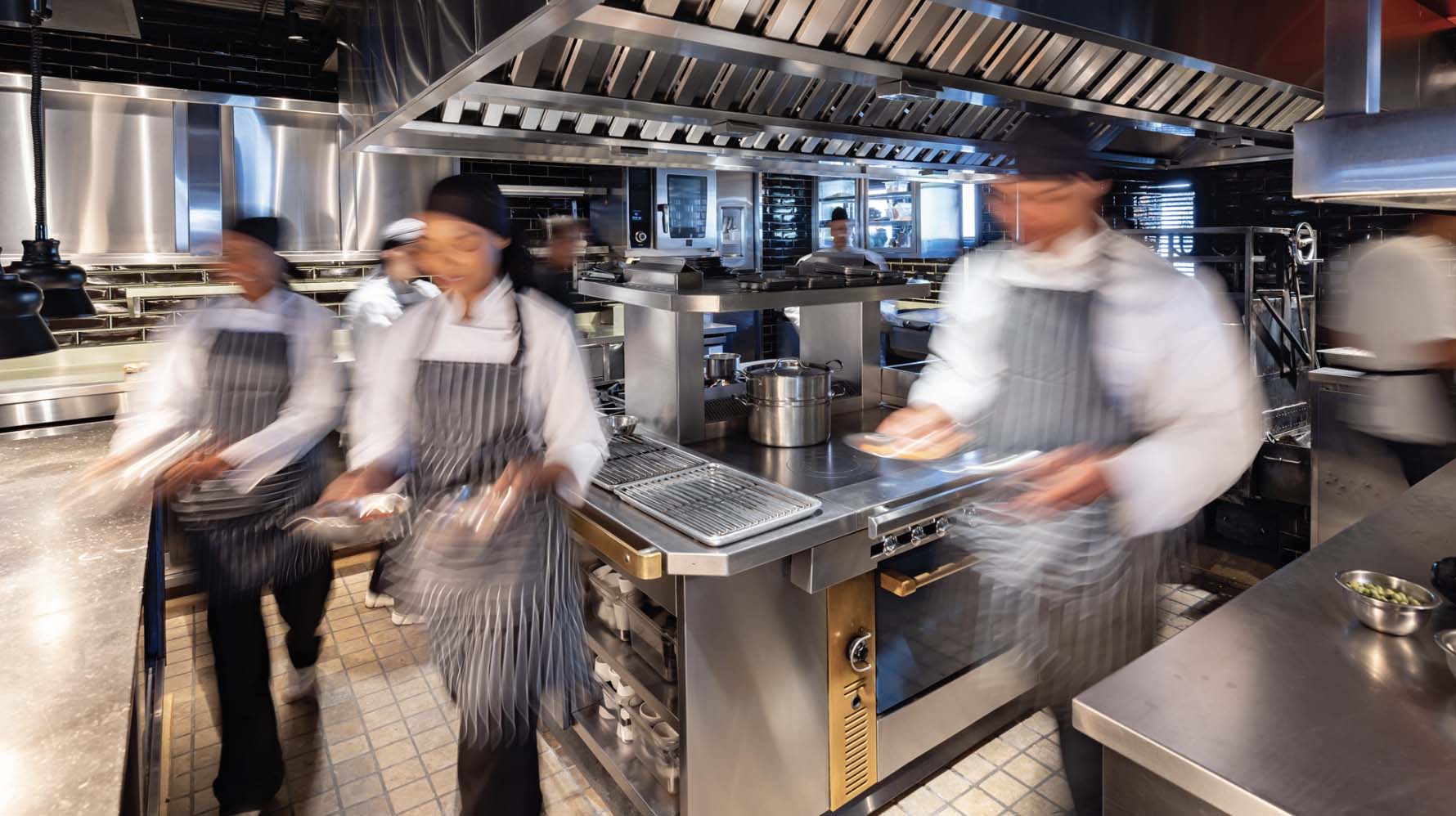
At a time when the talk around commercial kitchens is firmly centered on how automation will solve the problem of labor shortages by delivering consistency and quality with fewer people, it might seem contradictory to steer the conversation towards how kitchens can be best designed for the people who work in them. Yet, no matter how paradoxical it may seem, human engineering remains of paramount importance.
For now, the human element plays a central role in how a kitchen functions, so it makes no sense to expect people to adapt to poorly designed spaces or to work with equipment that is not built around ease of use and ergonomic considerations. Human-centered design is what makes a kitchen safe, efficient, comfortable, and creative.
“If architects are theologians of a concept, then human engineering celebrates that vision by making it a reality,” says MAS consultant Rudy Miick FCSI, president of The Miick Companies, LLC which helps foodservice organizations drive growth and profitability. “It is the articulation of making a piece of art actually function.”
Even the simplest things can make a huge difference to the human experience. Miick recalls seeing a multimillion-dollar kitchen development in which three out of five doors opened the wrong way. “They got in the way rather than supporting workflow,” he explains. “The human-centric element is a supporting and caring approach to designing a space. The first part is ergonomics, so you think about how a body flows and moves through space. Efficiency must be integrated with human dynamics.”
Raoul Cervantes, consultant services sales manager at Hatco, says it’s important to ask what problems you’re solving for the kitchen staff: “Our teams focus on identifying real operational needs, whether improving food quality, boosting efficiency, or making daily tasks safer and more comfortable. From there, we engineer equipment that directly addresses those challenges.”
Today’s design technology allows consultants to insert a human body into a virtual space to see the impact of how cabinets and doors open and close, how things flow, and how human activity changes the dynamics of a space.
“Human engineering is the discipline that analyzes and optimizes the relationship between people, processes, and the physical environment to ensure operations are efficient, safe, and consistent,” adds Mexico-based FCSI Associate Veronica Millares, CEO of Restaurantismo. “It starts by understanding how teams move, the decisions they make, the physical effort they repeat, and where operational friction occurs.”
Feeling the flow
The layout of a kitchen defines the workflow, the speed of production, and how taxing tasks are on the human body. Ergonomic design, which stems from the keen understanding of how bodies move through space, what people need to perform their tasks, and how those tasks fit with all other processes in a kitchen, directly influences productivity, efficiency, and throughput.
“Something simple like putting everything on casters can make a big difference,” says Miick. “If you can move equipment around so that a three-person line can be a two-person line or change the layout to increase production to suit the number of people working in the kitchen, then there is an immediate impact.”
A good design will consider adjacencies and how they affect what is required of a person working in the space. If a worker has to walk 100ft to get the ingredients or tools that they need, rather than 20ft, they will take five times longer to complete a task. Then there is a choice between slower service or hiring more bodies, resulting in a hit on cost or guest satisfaction and quality of service.
“Design moves beyond the simple placement of equipment and becomes a work system, where tasks, movements, and sequences are organized in a logical and progressive manner, avoiding unnecessary backtracking and operational crossovers that disrupt workflow,” says Millares. “The goal is for the operation to move naturally from the beginning to the end of the process, reducing rework, extra effort, and human error. In this approach, the system adapts to the operator, not the operator to the system.”
Many key principles underlie human engineering. One is applied anthropometry, which is used to define working heights, reaches, and clearances based on real user populations, rather than idealized standards. Another is biomechanics, which focuses on reducing forced postures, excessive reaching, and repetitive movements that cause physical wear. Third is cognitive ergonomics, which supports clear process sequencing, intuitive layouts, and better decision-making, thus helping to reduce operational errors under pressure.
“Finally, designing for fatigue is essential to sustain productivity in continuous or high-volume operations, where performance must remain stable over long shifts,” says Millares. “These principles are directly linked to well-established organizational and ergonomic theories, which demonstrate that improved working conditions lead to higher productivity, not because people work faster, but because the system reduces friction, variability, and unnecessary strain.”
John Pennington, vice president and director of sales and marketing of Accutemp, agrees that ergonomic design improves productivity. “A great example is a clamshell griddle paired with a refrigerated base,” he says. “This setup allows cooks to work more efficiently by reducing steps and getting product onto the griddle faster.”
Millares stresses that productivity increases when the environment supports focus, repeatability, and process stability, noting that in such a framework, technology is integrated as a tool to support operators, standardize tasks, streamline processes, and reduce errors.
“Equipment has changed a lot from cooking on open fires to combi ovens, and human engineering has been done to minimize physical stress on chefs, and to be more efficient with better food and less effort and energy,” says Glenn Campbell FCSI, founder and MD of UK-based Cohesion Consulting. “Ergonomics, efficiency and cost management are where human engineering has come to the fore.”
Simple stress-busting
The old adage ‘if you can’t stand the heat, stay out of the kitchen’ should be consigned to the scrapheap. Kitchens can no longer afford to be hot, hostile, stressful environments. Nevertheless, pre-WWII kitchens were very similar in height and dimensions to
the commercial kitchens of today, and many design principles are the same as in the 1930s.
So how come they are cooler, less hellish and more energy-efficient? The short answer is that equipment has evolved to prepare food faster and more efficiently, and to consider the environment in which people work. Moving from gas to induction cooking is not only more energy-efficient, but also creates less carbon dioxide, and a less toxic environment.
Everything from cookers to coolers have become simpler to use, to address the lack of skilled labor and the need for equipment to engage in crucial cooking processes at the touch of one button.
“Equipment might even be controlled by thought,” believes Miick. “That is not too far away, as we continue to move from complexity to simplicity.”
“Human engineering has a huge impact on output, quality and employee turnover, and that last factor is massive,” adds Juan Martinez FCSI, founder of consultancy Profitality. “Employers want to be employers of choice, even though working in a kitchen is more difficult than in a retail outlet, for example, and ergonomics has an impact on new employees coming in.”
Technology will certainly take over some tasks currently performed by humans, but the principles of efficient workflow and the need for less stressful environments will remain of prime importance as long as people are part of the foodservice industry.
“Human engineering focuses on designing systems that respond to how people actually work, move, and make decisions within the production environment,” adds Millares. “Ergonomics enables clearer workflows, better-balanced workstations, and more sustainable working conditions, where productivity emerges from system stability rather than staff exhaustion.”
While humans are still in the loop, ergonomics will define how well kitchens perform, so designers and manufacturers will have to understand not only how technology is evolving, but also what makes people tick.
Jim Banks


